 :
:  :
: 
How Logistics Parks Help E-Commerce Businesses Scale in Tier-2 and Tier-3 Cities
For years, India’s e-commerce growth was dominated by metro cities — Mumbai, Delhi, Bengaluru, Hyderabad. But the landscape has changed dramatically. Today, 70% of new e-commerce customers are emerging from Tier-2 and Tier-3 cities, driven by increasing internet penetration, digital payments, and changing buying habits.
However — selling to these regions comes with unique challenges: poor warehousing infrastructure, inconsistent transportation, higher delivery costs, and longer shipping timelines.
This is exactly where logistics parks play a transformative role.
What Is a Logistics Park?
A logistics park acts as a centralized hub for storage, distribution, and value-added services such as packaging, sorting, labelling, and last-mile delivery coordination.
It connects businesses with multiple transportation networks — road, air, rail, or ports — enabling faster and more cost-efficient product movement.
Why Tier-2 & Tier-3 Cities Matter for E-commerce
| Growth Driver | Impact |
|---|---|
| Rise of digital payments | Trust & repeat buying |
| Affordable smartphones | Broader market reach |
| Social commerce expansion | Localized purchases |
| Government initiatives | Infrastructure improvement |
Brands today understand one simple fact:
🚀 If you want to scale fast in India — you cannot ignore non-metro markets.
How Logistics Parks Enable Growth Beyond Metros
1️⃣ Reducing Shipping Time with Regional Warehousing
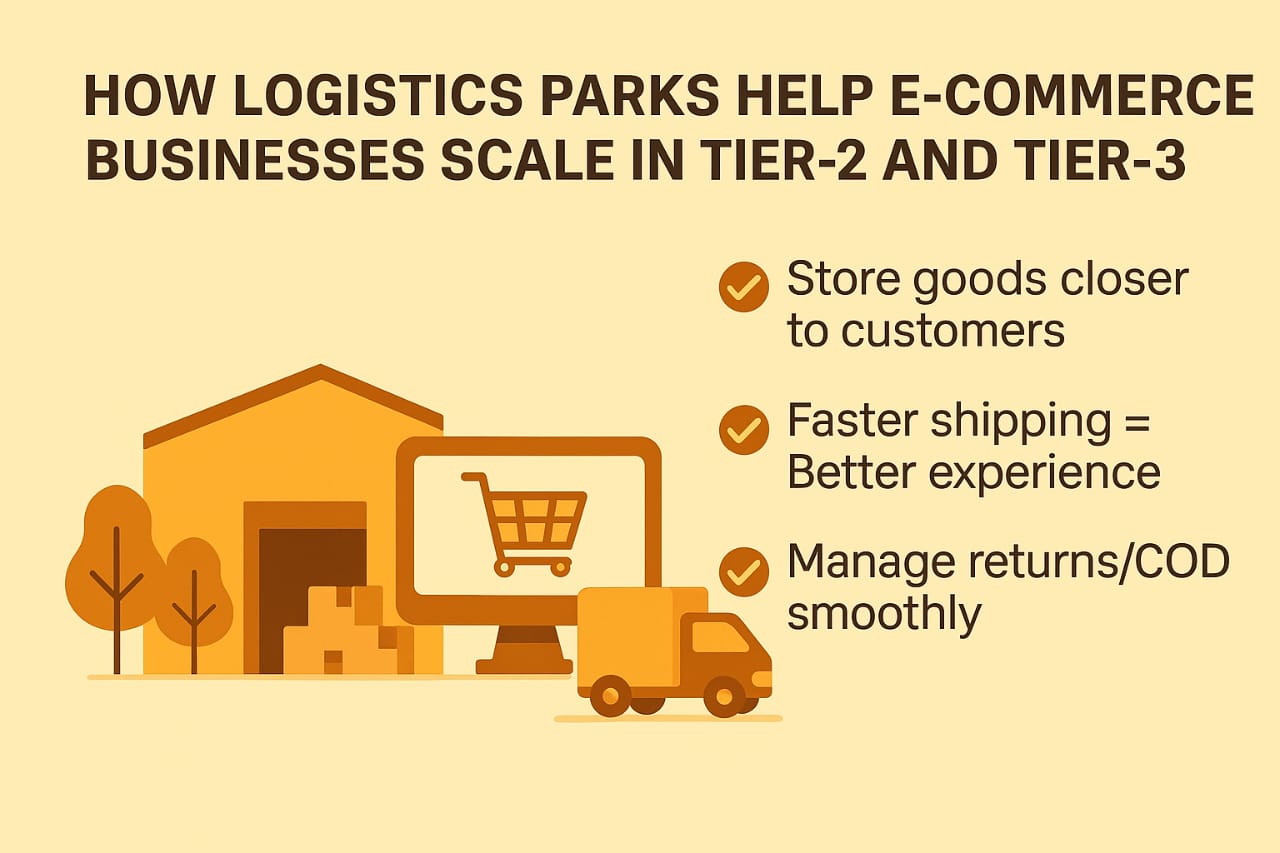
Instead of shipping from metro hubs, e-commerce sellers can store goods closer to customers.
Benefits:
-
1–2 day faster deliveries
-
Lower RTOs (return-to-origin)
-
Higher customer satisfaction
A customer in Varanasi shouldn’t wait 7 days for a parcel shipped from Mumbai — logistics parks solve this.
2️⃣ Lowering Supply Chain Costs
Transport is the costliest component of logistics.
With distribution centers located strategically:
-
Cost per shipment reduces
-
Reverse logistics (returns) become cheaper
-
Local distributors & wholesalers are better served
Saving ₹20–₹60 per shipment is a game-changer at scale.
3️⃣ Handling High Order Volumes During Festivals
Tier-2 & Tier-3 cities witness massive spikes during:
-
Diwali
-
Raksha Bandhan
-
Eid
-
Local festival markets
With pre-stocked inventory, logistics parks prevent stockouts and delayed delivery — turning peak season into peak revenue.
4️⃣ Supporting COD, Exchange & Returns Smoothly
A majority of orders in smaller cities are Cash-On-Delivery.
A local logistics hub:
-
Speeds up cash reconciliation
-
Simplifies exchanges
-
Reduces product damages
-
Builds customer trust
Fast returns = More repeat customers.
5️⃣ Better Reach for D2C and Small Businesses
A logistics park gives even a small brand the infrastructure of a big brand:
-
Scalable storage
-
Packaging support
-
Transport network access
-
B2B/B2C distribution
It levels the playing field — helping regional sellers go national.
Technology: The Backbone of Future Logistics Parks
Modern logistics parks integrate:
-
AI-based inventory forecasting
-
Smart routing and tracking systems
-
Automated packing and sorting
-
Warehouse management software
This technology ensures accuracy, speed, and transparency, which customers now expect as standard.
Conclusion: Logistics Parks Are the Growth Engine of Bharat’s E-Commerce Revolution
Tier-2 and Tier-3 cities are not “future markets” — they are today’s biggest opportunity.
With the right logistics ecosystem, businesses can scale quickly, reduce cost, and deliver faster — no matter how far the pin code lies.
For brands looking to expand deep into India, logistics parks are not just beneficial —
they are essential.
Recent Blog
Top Logistics Trends Every D2C Brand Must Know in 2026
Top Logistics Trends Every D2C Brand Should Know in 2026:…
How Generative AI Cuts Logistics Costs with Smart Automation
How Generative AI Is Reducing Logistics Costs: Unlocking Smart Automation…
Dark Stores vs Warehouses: Who Wins in 2026 Quick Commerce?
Dark Stores vs Warehouses: Which Model Wins in 2026? Estimated…
