Logistics planning is the backbone of every successful supply chain. Traditionally, this planning relied on manual processes—spreadsheets, human judgment, and static routes. But as order volumes grow and customer expectations rise, manual logistics planning struggles to keep up.
This is where AI-powered logistics planning delivers a clear advantage in both cost efficiency and time savings.
Understanding Manual Logistics Planning
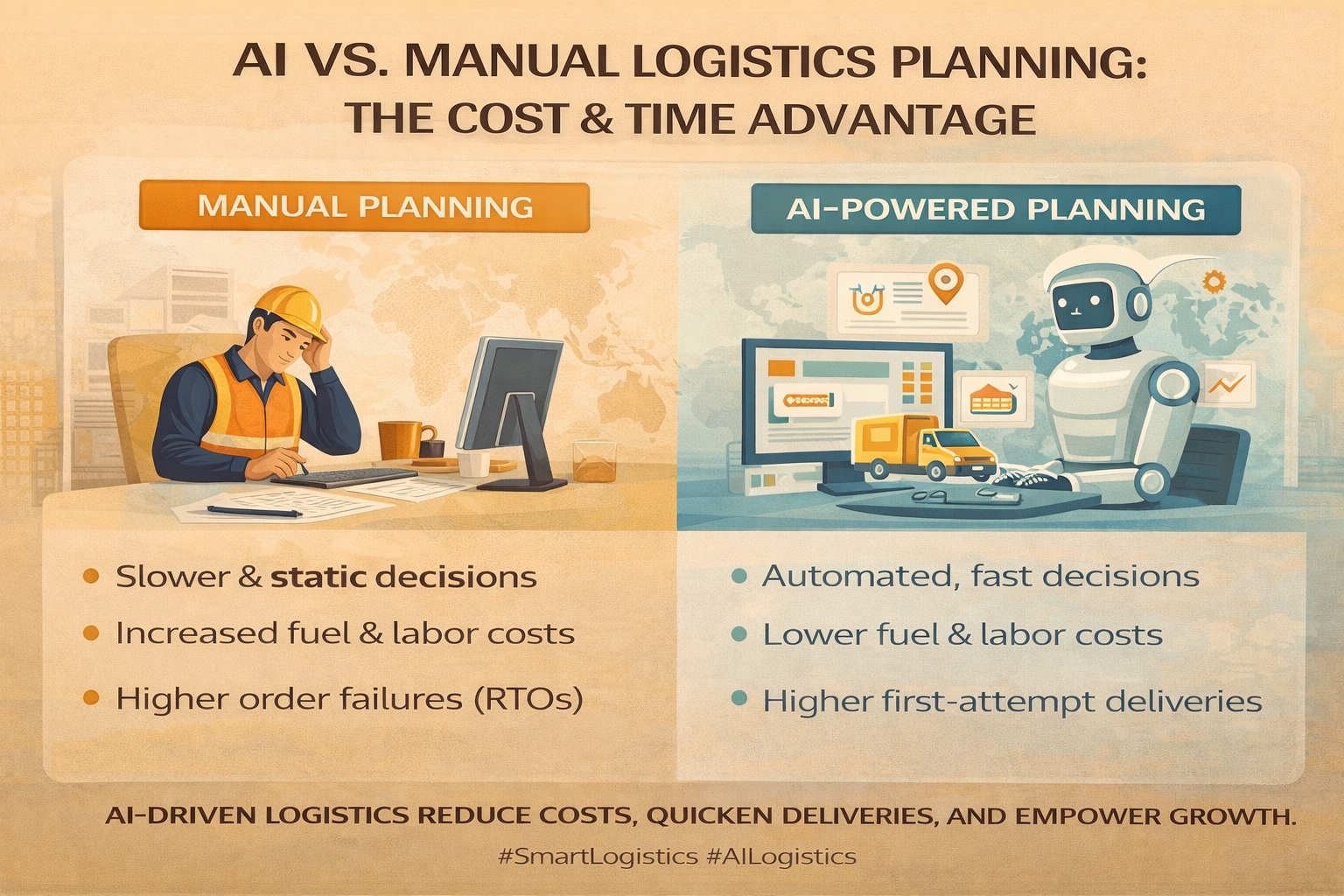
Manual logistics planning depends heavily on human intervention. Teams analyze data, assign couriers, plan routes, and manage inventory using experience and historical patterns.
While this approach may work at a small scale, it often leads to:
Manual planning simply cannot react fast enough to real-world changes.
How AI Transforms Logistics Planning
AI-powered logistics systems analyze vast amounts of data in real time. These systems continuously optimize decisions related to inventory, courier selection, routing, and dispatch.
AI considers:
The result is dynamic, data-driven decision-making—without human delays.
Cost Advantage: AI vs Manual Planning
Manual planning often leads to hidden costs:
-
Inefficient routes increase fuel usage
-
Poor courier selection raises RTOs
-
Overstocking or understocking inventory
-
Higher manpower costs
AI minimizes these costs by:
✔ Optimizing routes to reduce fuel consumption
✔ Selecting the most cost-effective courier per shipment
✔ Reducing failed deliveries and returns
✔ Lowering dependency on large planning teams
Over time, AI-driven logistics significantly reduces total operational expenses.
Time Advantage: Faster Decisions, Faster Deliveries
Manual logistics planning takes time—especially when changes are required mid-operation. AI systems make decisions instantly.
With AI:
-
Orders are assigned to couriers automatically
-
Routes are optimized in seconds
-
Dispatch happens faster
-
Delays are predicted and corrected proactively
This leads to shorter fulfillment cycles and faster customer deliveries.
Scalability: Where Manual Planning Falls Short
As businesses grow, manual systems struggle to manage complexity. AI-powered logistics scales effortlessly.
During peak seasons or sales events, AI:
-
Handles order spikes smoothly
-
Maintains delivery timelines
-
Reduces operational stress
Scalability becomes predictable rather than chaotic.
Accuracy & Reliability
Human error is unavoidable in manual planning. AI ensures consistency by following data-backed rules and continuously learning from outcomes.
This improves:
Conclusion: Smarter Planning Wins
Manual logistics planning may feel familiar—but familiarity comes at a cost. AI-driven logistics planning offers clear advantages in speed, accuracy, cost control, and scalability.
In today’s competitive e-commerce and logistics landscape, the choice is clear:
AI doesn’t replace logistics expertise—it amplifies it.
Because faster decisions lead to faster deliveries—and smarter planning leads to sustainable growth.
 :
:  :
: