 :
:  :
: 
What Exactly Is a Logistics Park and Why It Matters for E-Commerce
As e-commerce continues to grow, customer expectations around speed, accuracy, and reliability are higher than ever. Behind every successful online order is a strong logistics system—and at the center of that system is a logistics park.
But what exactly is a logistics park, and why has it become so important for e-commerce businesses today?
What Is a Logistics Park?
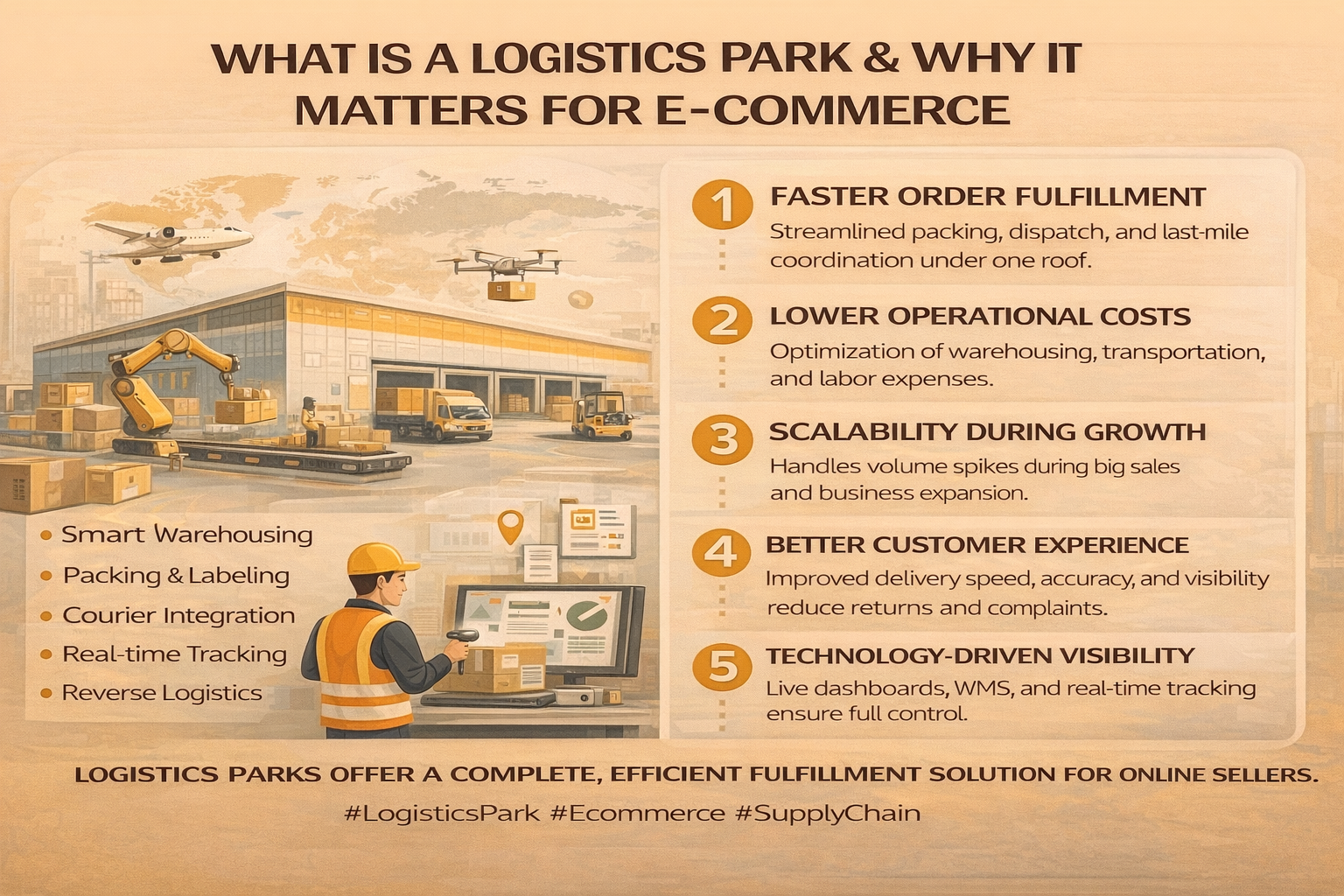
A logistics park is more than just a warehouse. It is a fully integrated logistics ecosystem designed to manage the complete movement of goods—from inbound supply to last-mile delivery.
A modern logistics park typically includes:
-
Smart warehousing & inventory management
-
Packing, labeling, and kitting services
-
Courier and transportation integration
-
Technology-driven tracking & reporting
-
Support for last-mile and reverse logistics
All these services operate from a centralized location, creating efficiency, speed, and visibility.
How Logistics Parks Are Different from Traditional Warehouses
Traditional warehouses mainly store goods. Logistics parks, on the other hand, actively manage and optimize supply chains.
| Traditional Warehouse | Logistics Park |
|---|---|
| Storage-focused | End-to-end fulfillment |
| Manual processes | Tech-enabled operations |
| Limited visibility | Real-time tracking |
| Separate vendors | Single integrated solution |
For e-commerce, this difference is critical.
Why Logistics Parks Matter for E-Commerce
1. Faster Order Fulfillment
With inventory, packing, and dispatch under one roof, orders move faster from checkout to shipment—reducing delivery timelines.
2. Lower Operational Costs
Shared infrastructure and optimized transportation reduce warehousing, manpower, and shipping costs.
3. Scalability During Growth
Logistics parks are built to handle volume spikes during sales, festive seasons, and rapid business expansion—without delays.
4. Better Customer Experience
Accurate orders, faster deliveries, and real-time tracking lead to fewer complaints, lower returns, and happier customers.
5. Technology-Driven Visibility
Warehouse management systems (WMS), AI-based courier selection, and live dashboards give sellers full control over their operations.
Why E-Commerce Brands Prefer Logistics Parks
For online sellers, managing logistics in-house can quickly become complex and expensive. Logistics parks allow brands to:
-
Focus on sales and marketing
-
Reduce logistics headaches
-
Enter new markets faster
-
Compete with larger brands
In short, logistics parks turn logistics from a challenge into a competitive advantage.
Conclusion: The Backbone of Modern E-Commerce
A logistics park is not just a place where goods are stored—it’s where speed, efficiency, and scalability come together. For e-commerce businesses looking to grow sustainably, logistics parks provide the infrastructure, technology, and expertise needed to meet customer expectations in a competitive market.
Because in e-commerce, success doesn’t just depend on what you sell—
it depends on how well you deliver.
Recent Blog
End the Hassle of Managing Multiple Courier Logins
Show the Pain of Juggling 5+ Courier Logins and How…
To-Pay vs Prepaid vs COD Explained for B2B Sellers
Understanding To-Pay vs Prepaid vs COD: What Every B2B Seller…
Complete Guide to Export Your Product from India Successfully
Here's the provided markdown converted to WordPress HTML format: I…
